


We use cookies to personalise content and ads, to provide social media features and to analyse our traffic. We also share information about your use of our site with our social media, advertising and analytics partners who may combine it with other information that you’ve provided to them or that they’ve collected from your use of their services.

Steve Kemp – Lateral Ankle Injuries in Professional Football – Injury Rehab Network Event
The expert guest speaker for the Injury Rehab Network event on 14th April 2022 was international football physiotherapist Steve Kemp who provided insight about his research into ankle injuries in professional football.

Steve Kemp – Lead Men’s Physiotherapist, England Senior Football Team
Steve Kemp is the men’s lead physiotherapist with the England Senior Football team, working with the team since 2013. He has been involved in 2 World Cup Finals (4th Place in Russia 2018) and 2 European Championships (runners up in 2021). Steve has worked in elite sports medicine for over 20 years both here in the UK and abroad. Following degrees in both physiotherapy and sports rehabilitation, Steve undertook a masters in the Science of Sports injury at Manchester University and a Postgraduate diploma in manual therapy at Birmingham University. He is currently studying for a PhD in Ankle Ligament rehabilitation at Imperial College London. He is a guest Lecturer at Birmingham University and University College London.
Steve spent 4 years as Head of Medical Services for Wolverhampton Wanderers before taking up a position as Elite Football Physiotherapist at the Perform Sport Medicine complex, based at St George’s Park. He has also had stints at Leeds United, Preston North End and Busan Icons in South Korea. Steve also consults privately for ‘The Football Clinic’ A multidisciplinary clinic consisting of orthopaedic surgeons, physiotherapists, and consultant radiologists out of the Manchester Institute of Health and Performance. He is a member of the Musculoskeletal Association of Chartered Physiotherapists (MACP) and is a Gold-accredited member of the Association of Chartered Physiotherapists in Sports Medicine (ACPSM).
Ankle Injuries in Professional Football
Steve’s presentation, “Lateral ankle injuries in professional football,” discussed his PhD at Imperial College London into ankle injuries in professional football. The lateral ankle ligament injury is one of the most prevalent injuries in professional football. Often dismissed as a minor innocuous injury they are one of the most recurrent injuries which suggests rehabilitation is often rushed or incomplete, and athletes return to sport too early. The presentation provided an up-to-date overview of the epidemiology, the current rehabilitation strategies, and the future direction of the management of these injuries.
£460 was Raised for the Running Bee Foundation
This in-person event was delivered in partnership with BASRaT with over sixty people joining the session on 14th April 2022 at UA92 in Manchester. Practitioners from sports teams across the UK attended together with staff and students from UA92.
Delegates were asked to pay a donation of £10 to attend this event with over £460 donated to the Manchester-based charity The Running Bee Foundation following the event! Through The Running Bee Foundation events, the charity champions health and wellbeing initiatives promotes the benefits of an active lifestyle and helps in the fight to reduce childhood obesity. The Running Bee Foundation make funding accessible to all parts of communities across Manchester with no restriction on age, financial status, religion, or gender.

Lateral ankle injuries in professional football
What is in question about lateral ankle injuries?
Steve commenced his presentation with the questions that his research has sought to answer including:
- Are ankle ligament injuries preventable?
- How good is conservative management of ankle injuries in professional football?
- What progress has been made in relation to ankle ligament injuries in football?
An introduction was provided to his 20-year career in professional football. Steve’s education started with a degree in Sport Rehabilitation followed by a degree in Physiotherapy, a master’s in the science of Sports Injury, Post Graduate Diploma in Manual Therapy, and a PhD in Bioengineering.
He has worked in various professional football clubs including roles at Leeds United Academy, Busan Icons (South Korea), Wolves FC, Preston North End, Perform St George’s Park and his current role with The Football Association. Steve has been part of the medical team at 4 Youth FIFA World Cup Finals, 2 Senior FIFA World Cup Finals and 2 Senior UEFA European Championships.

Ankle Anatomy Revision
Steve presented a series of graphics and images showing the anatomy of the ankle including ligaments and tendons of the lateral and medial aspects.
Are ankle ligament injuries preventable?
A point of discussion was whether lateral ankle sprains in football are preventable, if recurrence rates in professional football are high and if recurrence rates can be reduced. Steve also considered post-traumatic arthritis and if this is an issue in the retired professional footballer.
A series of clips were shown, demonstrating both good technique and some of the reasons why ankle injuries occur. Steve described how when changing direction an athlete should place their foot outside the base of support to create sound initial contact to enable activation with the hip, knee, and trunk in an efficient position. What should not happen is the incorrect landing position where the foot is excessively inverted on ground contact. Injuries often occur on a straight leg causing the ground reaction force to act on the lateral foot edge.
Steve presented research findings into reaction times to sudden ankle inversion showing that an ankle sprain happens in just 0.03 seconds.
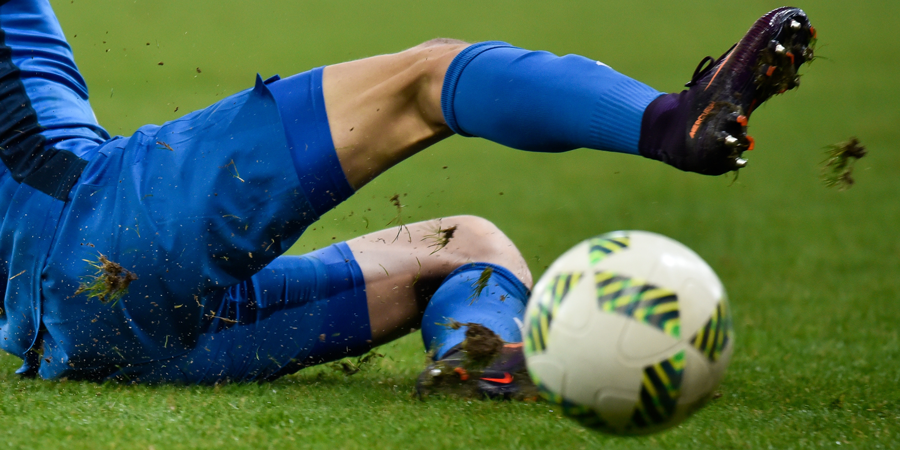
He described that good technique and injury prevention programmes can reduce the incidence of ankle injuries but there are always risks in sport and some injuries can not be prevented. This is particularly true with uncontrollable factors such as the tackle in football. Other factors such as the pitch/ playing surface and surfaces around the pitch may also cause injuries and could be assessed and improved to help reduce ankle injuries. Recent changes to rules such as making two-footed/ slide tackles illegal have helped to reduce injuries and statistics show that ankle injuries are declining. Steve described that whilst contact related injuries are declining there is an increase in non-contact match injuries.
Are recurrence rates high in professional football?
Steve discussed the recurrence rates of ankle injuries in professional football and whether recurrence rates can be reduced. In a study of UEFA elite clubs, re-injury rates have reduced over sixteen seasons.
Steve described how athletes commonly return to sport with pain, functional and movement impairments with a high prevalence of re-injury and persistent symptoms within 1 year. Studies show recurrence rates in Men’s football ranging between 8% for international football to 13% for elite club football. Steve discussed differences with women’s football where data for women’s international football currently shows a 5% recurrence rate.
Players are keen to return to play as soon as possible and Steve discussed the current data with the median time for return to play from a lateral ankle ligament sprain at 7 days and 95% of athletes returning to play within 10 days.
Is post-traumatic arthritis an issue in the retired professional footballer?
Steve described how as many as 78% of chronic ankle instability (CAI) patients develop post-traumatic Osteo Arthritis (PTOA). Ninety percent of patients with CAI require surgical intervention. Steve discussed the differences between professional footballers and the general population with 12-17% of professional footballers with ankle Osteo Arthritis compared to 1% in the general population.
Ankle injury prevention and recurrence
Not all lateral ankle injuries are preventable, but work can be done on sensory-motor control to improve foot placement and strength to mediate risk.
Steve discussed recurrence rates and stated that recurrence can be reduced but benchmarks are required for return to play protocols.
With regards to post-traumatic arthritis, Steve described how rates are high in retired professional footballers, but this is likely to be reduced if initial rehab is more comprehensive.
How good is conservative management of lateral ankle injuries in professional football?
With regards to conservative management, Steve posed the following questions:
- Are lateral ankle ligament injuries a real problem in professional football?
- Is conservative management effective?
- What prospective evidence for return to sport criteria do we have for lateral ankle ligament injury?
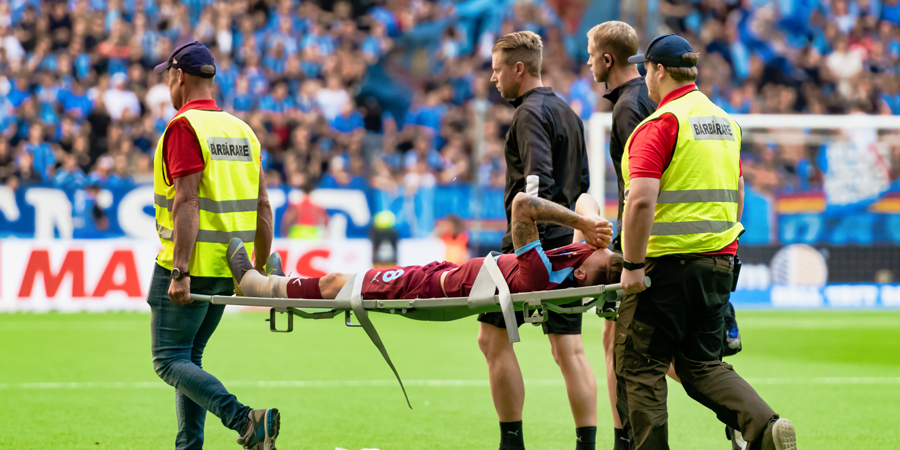
Steve discussed the epidemiology of the most common football injuries with data showing a high prevalence of ankle injuries. Return to play for ankle sprain injuries is a median of 7 days and a mean of 15 days with reinjury rates for ligament injuries at 13-14%.
He described how 67% of ankle injuries are ligamentous with the acute inflammatory phase lasting around 3 days, proliferative phase from 3 to 13 days and remodelling phase from 15 to 30 days.
Steve discussed the reasons for recurrences of ankle injuries including a desire from players and coaches, lack of pain, attitudes towards ankle sprain injuries ‘it is only a sprain?’ and there a no return to play guidelines or benchmarks. There are no prospective studies for return to sport decision making and systematic reviews have identified that whilst rehabilitation exercises reduce reinjury post ankle sprain, an optimal exercise programme is yet to be established.
Steve described how there is existing good practice in relation to hamstring injury management. He discussed research by Michelle Smith at the University of Queensland about return to play from lateral ankle injuries. Michelle’s research has developed an assessment protocol for the following with the PAASS acronym:
- Pain
- Ankle impairments
- Athlete perception (confidence/ readiness)
- Sport-specific testing (functional tests)
- Sensorimotor control
Steve discussed the research from the University of Queensland and potential limitations in relation to which tests should be used, the evidence for which tests are more applicable and the benchmarks to determine safe return to play. He explored PAASS, the evidence and options available for tests and benchmarks.
Steve summarised by answering the questions regarding conservative management of ankle injuries with evidence showing that after hamstring injuries (13.8%), a lateral ankle sprain is the most prevalent injury (6.3%). Evidence for conservative management is not sufficient and that return to sport criteria for lateral ankle sprains is required.

The future direction for research and management of ankle ligament injury
Steve discussed the problem of lateral ankle sprain injuries being common in professional football with high reoccurrence rates, and the reason for reoccurrence is yet unknown. Rehabilitation focuses on the physical qualities of the ankle and accurate measurement of these qualities is essential to ensure comprehensive rehab.
Steve discussed potential research questions including:
- What is the prevalence of lateral ankle sprain injuries and recurrences in professional football?
- What outcome measures are used to manage the progression of lateral ankle sprain rehab and successful return to play?
- Could novel technology be adapted to support the management of lateral ankle sprain rehab and successful return to play in the clinical setting?
His research aims to assess the cost of lateral ankle sprain injuries in men’s and women’s international and domestic professional football, to establish the outcome measures currently being used to support return to play in professional football and identify the solution.
Steve discussed how the solution will assess the reliability of an Inertial Measurement Unit (IMU) to measure performance in a Functional Performance Test (FPT), assess the validity of an IMU in comparison with force platforms and motion capture, and investigate the performance of FPT using an IMU in professional footballers with a history of ankle injury versus their non-injured limb.
He discussed ankle injury incidence in matches and training for both the men’s and women’s games, with lower rates for ankle injuries in women’s matches but higher rates in women’s training. He described how the cause and onset of ankle injuries are higher in senior men’s matches compared to women’s matches. Injuries in training are significantly higher in women’s youth than men’s youth. Contact injuries are more prevalent in men’s senior football whereas non-contact injuries are more prevalent in women’s senior football. Over half of injuries are minor with return to play between 1 and 7 days.
Steve described Functional Performance Tasks (FPT) and their validity including figure of eight hop test, side hop test, crossover hop test and square hop test.
He discussed how Inertial Measurement Units (IMU) are becoming increasingly prevalent as a method for low cost and portable analysis. IMUs are used to obtain data about stride length and temporal events of gait. Steve discussed the 10:5 hop test and how this test is a simple and effective way to assess the reactive strength of the ankle (a key determinant of good technique).
He described how rehab should be specific to the injury and specific to the demands of the sport. Outcome measures should aim to reduce contact times, assess multiple planes of movement, assess max speed, speed endurance, and have a high proprioceptive and neuromuscular component. Outcome measures should also be reliable, repeatable, and benchmarked with ecological validity.
Follow Steve Kemp
Twitter – @physiostevekemp
Instagram – @Stevethephysio
Future Event Details
- 27th April 2022 at 5:30pm – Cristian Fernández (Rehab Fitness Coach) and Dr Lee Herrington (Physiotherapist and Senior Lecturer in Sports Rehabilitation)
- 19th May 2022 at 7pm – Tom Parry (Head of Performance Nutrition, Manchester City FC)
- 14th June 2022 at 7pm – Dr Andrew Newton (Consultant in Emergency Medicine)
- 7th July 2022 at 7pm – Dr Carl Todd (Consultant Osteopath in Sport & Exercise Medicine)
- 20th September 2022 at 7pm – Dr Monna Arvinen-Barrow (Chartered Psychologist & Associate Professor University of Wisconsin-Milwaukee)
Read more about the programme of events for 2022 and register your interest here.
Please enter your details into the form below along with any questions or comments and a member of our team will be happy to provide you with more information:
Get in Touch
- Sarah Perris — HerACLJourney — Injury Rehab Network
- Pitchside to Ringside: Essential First Aid Kits for Contact Sports
- Simon Shepard — The Challenges of Cricket — Injury Rehab Network
- Helena Walker — Working in Academy Rugby Union: The Highs, Lows & Everything in Between — Injury Rehab Network
- Dr Adam White — Brain Health – Current Evidence and Strategies — Injury Rehab Network
- Prof James Hull — Breathing to Win — Injury Rehab Network
- Mark Leather — Professional Football Medical Support Q&A — Injury Rehab Network
- Mike James — Rebooting Robot Rehab — Injury Rehab Network
- Mike Davison — Organisational Design Principles — Injury Rehab Network
- Professor John Ryan — Abdominal Injuries in Sport — Injury Rehab Network
- Dr Rebecca Robinson — Exercise, Medicine and Cancer — Injury Rehab Network
- Dr David White — Exercise Induced Leg Pain — Injury Rehab Network
- Professor Joideep Phadnis – Treatment and Management of Elbow Injuries – Injury Rehab Network
- 2026 Injury Rehab Network Events
- Professor Robert Galloway – Reducing Medical Errors – Injury Rehab Network
- Steven Corbett – Management and Treatment of Shoulder Injuries in Sport – Injury Rehab Network
- Ali Emery – Sport Rehab & Medical Provision in UK Ice Hockey – Injury Rehab Network
- Dr Josh Berkowitz – Haematology in Sports Medicine – Injury Rehab Network
- Dr John Rogers – Bone Stress Injuries – Injury Rehab Network
- Dr Jon Houghton – Tendon Injuries – Injury Rehab Network
- Dr Andrew Harrison – Fracture Management – Injury Rehab Network
- Nick Metcalfe – Hamstring injuries: Lumbar spine and Pelvis considerations – Injury Rehab Network
- Nick Worth – The Medico-Legal Field in Elite Football/ Sports – Injury Rehab Network
- Dr Nicola Keay – Health and Hormones in the Master’s Athlete Age Group – Injury Rehab Network
- Female Athlete Health – Injury Rehab Network
- Dr Geoff Davies – Behind the Scenes with the WRU and British & Irish Lions Team Doctor – Injury Rehab Network
- Douglas Hammond – Facial Injuries in Sport – Injury rehab Network
- 2025 Injury Rehab Network Events
- Claire Robertson – Patellofemoral Update – Injury Rehab Network
- Colin Lewin – Soft Skills in Professional Sport – Injury Rehab Network
- Des Ryan – Youth Athletic Development – Injury Rehab Network
- Dr Carly McKay – Injury prevention in rugby and football: are we making any progress? – Injury Rehab Network
- Micki Cuppett – Clinical Pearls to Enhance Your Medical Examination Skills – Injury Rehab Network
- Dr. Ian Beasley – Ex-footballers Healthcare – Injury Rehab Network
- Siobhan O’Donovan — Busting Booby Traps — Injury Rehab Network
- Angela Jackson — Integrating Neurocognitive Rehab in to Return to Sport Protocols — Injury Rehab Network
- Dr Andrew Shafik — Working as a Doctor in English Football — Injury Rehab Network
- Dr Nicola Keay — Relative Energy Deficiency in Sport (REDs) — Injury Rehab Network
- Ian Hunt – Modern Management of Chest, Rib and Sternal Injuries in the Elite Athlete – Injury Rehab Network
- Dr Amit Mistry – Mental Health Challenges in Elite Sport – Injury Rehab Network
- Head Injuries and Sport
- Gerard Greene – Male Athletic Pelvic Health – Injury Rehab Network
- Geraint Griffiths – The Prevention of and Rehabilitation from Visually Related Sporting Morbidity – Injury Rehab Network
- Professor David Lloyd – Surgery for Groin Pain – The Lloyd Release Procedure – Injury Rehab Network Event
- 2024 Injury Rehab Network Events
- Jonathan Bell FRCS (ORTH) – Meniscus Tears and other Complex Injuries of the Knee – Injury Rehab Network
- Professor Rowena Johnson – Imaging of Groin and Hip Pain in Athletes – Injury Rehab Network
- Prehab & Rehab in Elite/ Professional Football – Injury Rehab Network Event
- Steve Phillips – Calf Muscle Injuries – Injury Rehab Network Event
- Grant Downie OBE – Maximising your Impact in the VUCA World of Professional Football – Injury Rehab Network Event
- Manchester FA and Sterosport Partnership Aims for Manchester to be the Safest Place to Play
- Dr Marwan Al-Dawoud – Concussion in Rugby – Injury Rehab Network Event
- How to Strap Your Ankle
- John Dickinson – Optimising Care for Asthma and Disordered Breathing Patterns in Athletes – Injury Rehab Network Event
- How to Apply Sports Tape to Your Knee
- Dr Wayne Diesel – My Long Walk to Retirement – Injury Rehab Network Event
- Rugby Union and Rugby League Mandatory Medical Equipment : 2023 Update and What to Buy
- Leanne Simoncelli – Optimising and Individualising ACLR Rehabilitation – Injury Rehab Network Event
- Lessons from Working in Elite Football – Injury Rehab Network February 2023
- The Most Common Hockey Injuries and How to Prevent Them
- How to Treat Common Hockey Injuries
- Andy Williams – ACL Reconstruction in Professional Athletes – A Surgeon’s Perspective – Injury Rehab Network Event
- Steve Simbler MRPharm.S – Medicines Management in Sport – Injury Rehab Network Event
- Hockey and Ice Hockey Injury Statistics
- Essential Hockey Safety Equipment
- How to Perform a Risk Assessment for Sports: The Ultimate Guide (Including Examples and Template)
- How to Treat Common Cycling Injuries
- Preventing Common Cycling Injuries
- Professor Iain Hutchison – Sporting Facial Injuries and Treatment Delivering Speedy Recovery – Injury Rehab Network Event
- Hockey First Aid Kit Contents List
- Hockey First Aid Kits
- How to Treat Common Netball Injuries
- Gary Bloom – Why do Players Suddenly Experience a Catastrophic Loss of Form – Injury Rehab Network Event
- Dr Monna Arvinen-Barrow – Rehabilitation of the Biopsychosocial Athlete – Injury Rehab Network Event
- How Can Common Netball Injuries be Prevented?
- First Aid Qualifications for Netball
- Netball First Aid Kits
- Netball First Aid Kit Contents List
- 2023 Injury Rehab Network Events
- Essential Safety Equipment for Cricketers
- Fiona Rosamond – Podiatry in Football – Injury Rehab Network Event
- Essential First Aid Skills for Cricket Coaches
- Common Cricket Injuries and How to Avoid Them
- Dr Carl Todd – Osteopathy in Football – Injury Rehab Network Event
- Dr Andrew Newton – Grass Roots Paediatric Sports Medical Issues – Injury Rehab Network
- Tom Parry – Nutrition in Premier League Football – Injury Rehab Network Event
- Cricket First Aid Kit Contents List
- A Guide to Cricket First Aid Kits
- Treatment and Prevention of Cauliflower Ear
- How to Treat Common Rugby Injuries
- Rugby First Aid Courses: Everything you Need to Know
- The Definitive Rugby First Aid Kit Contents List
- Taping Your Wrists for Football: Why and How
- Effective Prevention of Injuries in Football
- How to Treat Common Football Injuries
- Rugby First Aid Kits: Complete Guidance for Rugby Union and Rugby League
- Knee Injuries in Professional Football and Elite Sport – Injury Rehab Network Event
- Steve Kemp – Lateral Ankle Injuries in Professional Football – Injury Rehab Network Event
- Michael Blackie BDS – Oral Health Impact on Performance in Elite Sport
- The Best Football First Aid Courses Recommended by Experts – Courses your coaches should be taking and why
- Football First Aid Kit Contents List – What should yours contain to keep your football players safe?
- Boxing First Aid Kit Contents List
- Preventing and Treating Shin Splints
- 8 Essential Safety Tips for Boxing
- How to Apply Boxing Hand and Wrist Wraps
- Essential Boxing Safety Equipment
- How to Spot and Treat an ACL Tear
- How to Treat a Pulled Hamstring
- How to Treat a Groin Strain
- How to Treat a Sprained Ankle
- Essential Parts of Any Sports First Aid Kit
- Recommended First Aid Courses for Sport
- Essential First Aid Skills for Cyclists
- Cycling First Aid Kit Contents List
- Cycling First Aid Kits – A Complete Guide
- Mike Healy – Pitchside Care CPD – Injury Rehab Network Event
- David Fevre – Pitch Side Injuries: No Time to be Injured – Injury Rehab Network Event
- Diane Ryding – Physiotherapy in an Elite Football Academy: Beyond injuries – Injury Rehab Network Event
- The Strain of Christmas – A Busy Time for Physio’s
- Dr Imtiaz Ahmad: Football Club Doctor – An Evolving Role – Injury Rehab Network Event
- Diane Ryding & David Fevre at the Injury Rehab Network
- GB Maxibasketball and Sterosport Partnership Announcement
- Sterosport and FMPA Partnership Announcement
- 2022 Injury Rehab Network Events
- Dr Ian Horsley, Team GB Deputy Chief Physio, at the Injury Rehab Network
- Sign Up: Sports Taping and Kinesiology Taping Online Courses
- Dr Barry Monk – Sunshine and Skin Cancer – Injury Rehab Network Event
- Steve Miller – Calf Injury Rehabilitation – Injury Rehab Network Event
- Angela Jackson – Managing The Overloaded Younger Athlete – Injury Rehab Network Event
- Shoulder Injuries in Sport – Expert Q&A Injury Rehab Network Event
- Professor Bill Ribbans – The Athletic Ankle. When do Lax Ligaments Need Surgery? – Injury Rehab Network
- Diane Ryding – Tackling Paediatric Injuries – Injury Rehab Network
- What are the most common sports injuries? Top Ten (Part 2)
- What are the most common sports injuries? Top Ten (Part 1)
- The Athletes Shoulder – The Surgeons Perspective – Injury Rehab Network Event
- Dr Claire Minshull – Getting Efficacious About Rehab and Conditioning – Injury Rehab Network Event
- How to Conduct a Risk Assessment for the Return to Sport
- Return to sport: A complete guide on what to expect
- Types of Sports Tape and their Uses
- Gary Lewin, Expert Football Physiotherapist – Rehabilitation on the Road in Elite Sport – Injury Rehab Network Event
- Josh Quigley at the Injury Rehab Network
- 2021 Injury Rehab Network Events
- The Importance of the Partnership Between a Manager and a Physio
- Paul Lubas – The Pitch-Side Paramedic
- Returning to Work as a Sports Therapist After Coronavirus
- Hyde United FC and Sterosport Partnership Announcement
- Chorley FC and Sterosport Partnership Announcement
- British American Football and Sterosport Partnership Announcement
- Dave Fevre – Expert Chartered Sports Physiotherapist – Injury Rehab Network Event
- Does Kinesiology Tape Work?
- Here To Help When You Return To Sport
- Mike James at the Injury Rehab Network
- Hannah Dines Shares Details About Her Paralympic Cycling Programme
- Hannah Dines – Hills Thrills and No Chills on the Road to Tokyo 2020
- Dave Fevre at the Injury Rehab Network
- Hannah Dines – When an Athlete Switches Off
- Hannah Dines – Life Balance – How Friends Are Key to Elite Success
- University of Salford Sports Taping Courses
- Hannah Dines – Love Island, Laundry, Admin and Repeat – A Day in the Life of a Paralympian
- Injured? Here’s How Nutrition Can Help
- Sterosport – A New Approach to Sports Injuries
- Hannah Dines – Terminating Injury
- Injury Rehab Network NW Gets off to a Flying Start