


Geraint Griffiths – The Prevention of and Rehabilitation from Visually Related Sporting Morbidity – Injury Rehab Network

The final Injury Rehab Network event of 2023 with BASRaT featured Geraint Griffiths, Optometrist. The online event took place on the evening of 6th December, with 140 sports rehabilitation practitioners in attendance.
Geraint discussed how sporting performance is directly related to vision. The recording is available to watch here.

Geraint Griffiths, Optometrist (Sport Vision UK and Optical3 Opticians)
Geraint Griffiths: BSc Mech Eng., MSc Optometry and vision sciences, Dip Schoolvision, Dip Sportvision, MASvP MCOptom.
Geraint is the proprietor of Optical3 Opticians and Managing director of SVUK Ltd. He is the author of the Diplomas in Sport and Schoolvision Practice and Chair of the Association of Sport and Schoolvision Practitioners (ASvP)
He is also a former College of Optometrists examiner and Councilor for the East Midlands region (2008 – 2020) and Sports Vision expert to the British Standards Institute, BSI committee PH2, Safety eyewear, with a special interest in leisure wear and sunglasses.
His current research is around the prevention of ocular, systemic and psychological morbidity through an understanding of the relationship between binocular vision and occupational visual needs, including reading difficulties and sports.
His interest in biomechanics (binocular vision) was inspired by his first degree in Mechanical Engineering, dyslexia, and his Optometrist father. In athletics, Geraint represented Great Britain internationally and held the Welsh High Jump record for three years. He held the British Masters’ record for 11 years.
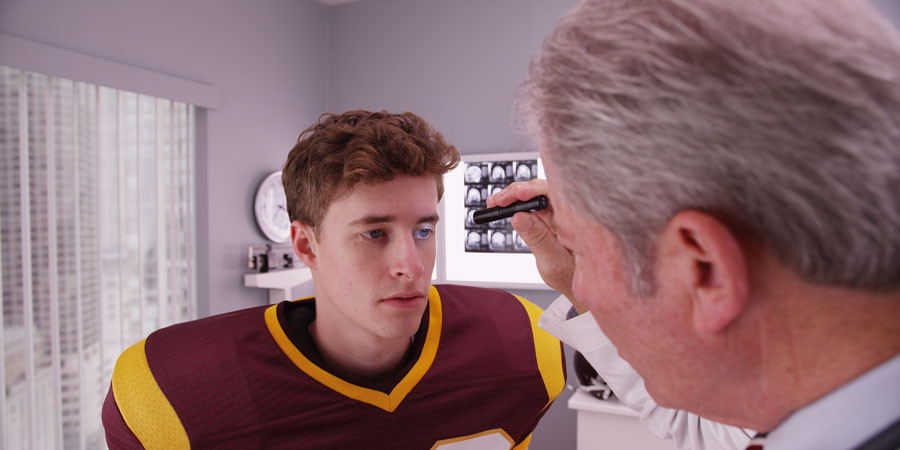
The prevention of and rehabilitation from visually related sporting morbidity
Geraint discussed how sporting performance is directly related to vision and how optimising vision or correcting existing visual problems is the most important preparation for competitive sport.
In his presentation, Geraint considered eye protection, contact lenses, the role of eye dominance and the predisposition to:
- Dyspraxia
- Dyslexia
- Different sports
Geraint examined a theory of sporting visual psychology, the effect of visual and general fatigue, prevention of acquired disease and understanding of sporting excess, including:
- Arthritis
- Stress fractures
- Drug abuse
Introduction
Geraint provided a background into his childhood and personal experiences with sports. After failing the 11+, Geraint was frustrated and had a chip on his shoulder. He put his energy into sports, where he achieved highly in athletics. It became clear that dyslexia made learning and sports more challenging for Geraint.
Geraint followed in his father’s footsteps to become an Optometrist and became involved with the Sports Vision Association. Geraint’s career has spanned 30 years, including screening of elite athletes for visual problems.
Evidence-based approach
Geraint became involved in research as there was no science to connect visual correction and sporting performance. Research was conducted to identify athletes at risk and to gain insight into:
- Whether eyesight is related to athletic performance.
- The importance of vision for sporting performance.
The research considered eye dominance, with findings showing that eye dominance is sport-specific. Eye dominance was measured in different sports using monocular fogging.

Geraint described how in sports like clay shooting, aiming is particularly important whilst sports like tennis require depth perception. Athletes with less stable eye dominance need to rely more on monocular clues.
Principles of Sporting Performance
Geraint discussed how sporting performance is based on the primary visual skills of aiming and anticipation (depth perception).
- Sporting performance is controlled by vision throughout life.
- Sporting performance is dependent on the maintenance of established binocular vision.
- A deficiency in visual performance will inhibit the development of sporting potential.
Geraint recommends regular assessments for athletes.

Role of aiming in soccer
Geraint described the four-part process of aiming in soccer:
- Body position gives direction for free kicks.
- Eye, foot, ball = accurate kick/ direct shot at goal.
- The aim includes a calculation for induced spin (aerodynamic flow).
- Acute peripheral awareness.
- Corrections may be required for eye dominance.
The effects on play and potential for injury prevention were considered by Geraint as follows:
- Getting caught on the ball.
- Mistiming tackles.
- Slicing a pass.
- Mistiming a header.
- Reduced peripheral awareness.
Visual correction techniques include:
- Contact lenses.
- Protective eyewear.
- Protection from sun/ glare.

Geraint described how visual problems could lead to frustrations of failure, and he recommends that athletes should seek a visual explanation first if sporting performance deteriorates.
Geraint also considered a range of refractive causes which should be assessed.
Role of aiming in education
Geraint discussed how sport requires innate intelligence to facilitate high levels of coordination and calculations. In education, visual problems can be associated with:
- Reading – interocular coordination
- Clumsiness – eye-body coordination
- Poor writing – hand-eye coordination
- Trouble with arithmetic – interocular coordination
Geraint considered how the classroom experience can be a strong motivator for athletic excellence.
The energy demand of the visual system and dietary effects
Geraint explained how the visual system ranks amongst the highest energy-consuming systems, with the brain consuming 20% of total oxygen and a quarter of the total glucose.
Diet can, therefore impact the visual system, including issues associated with:
- Insulin resistance
- Type II diabetes
- Obesity
- Raised blood pressure
- Addictive hyper/ hypoglycaemic cycle
- Inflammatory – autoimmune disease
Other health problems and the visual system
Geraint discussed arthritis and how exercise supports vision and ocular health, but arthritis prevents it. There is optical interest for Iritis, Scleritis, Keratoconus and Sjogren’s syndrome.
Vision problems can also impact on mental health. Geraint described the link between binocular deficit and depression. Binocular vision is energy-dependent. Triggers for relapse may include:
- Extreme athletic events
- Over exercise/ training
- Excessive workload
- Poor health
- Loss of contact lenses/ glasses
Depression may be linked to low blood sugar and binocular deficit.
Psychology of Poor Sporting Performance
Poor sporting performance may impact on the mental and physical well-being of athletes. Geraint concluded his presentation by stating that visual performance is the most important consideration in the preparation for competitive sports.
Q&A
Geraint kindly answered questions put forward by practitioners who attended the session. Please see the presentation recording for the insights from Geraint to the questions.
Presentation Recording
The recording of Geraint’s presentation is available to watch here
Follow Geraint Griffiths
- Website sportvision.co.uk
- Email geraint@sportvision.co.uk
2024 Injury Rehab Network events
Find out about and register your interest for all the Injury Rehab Network events with BASRaT planned for 2024
Please enter your details into the form below along with any questions or comments, and a member of our team will be happy to provide you with more information:
Get in Touch


Related Insights
 Basketball
Helena Walker — Working in Academy Rugby Union: The Highs, Lows & Everything in Between — Injury Rehab Network
The latest Injury Rehab Network event featured a highly practical and honest presentation from Helena...
 Basketball
Dr Adam White — Brain Health – Current Evidence and Strategies — Injury Rehab Network
The latest Injury Rehab Network event featured a highly important and thought-provoking presentation from Dr....
 Basketball
Prof James Hull — Breathing to Win — Injury Rehab Network
In our latest Injury Rehab Network event hosted by Sterosport and BASRaT, we had the...